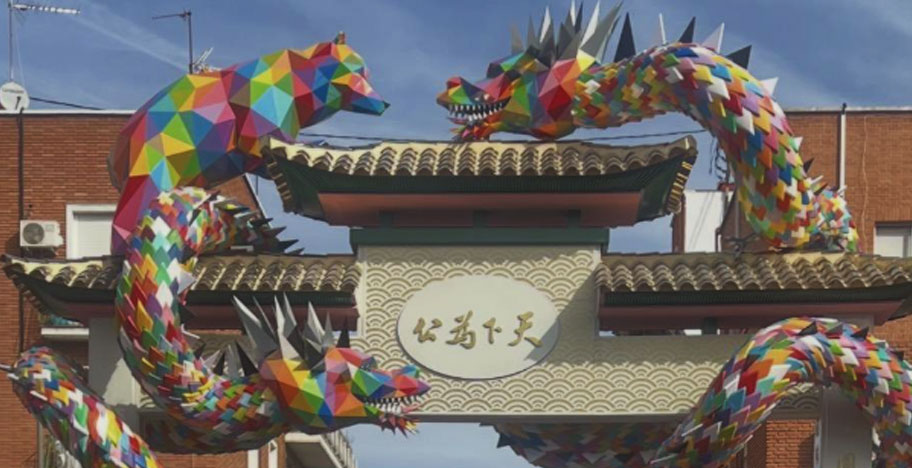
Plaza del Hidrógeno is home to Two Cultures in Love, a work by Okuda San Miguel created with the participation of the district’s Chinese community. The installation completes the pedestrian route connecting Madrid Río with the heart of Usera.
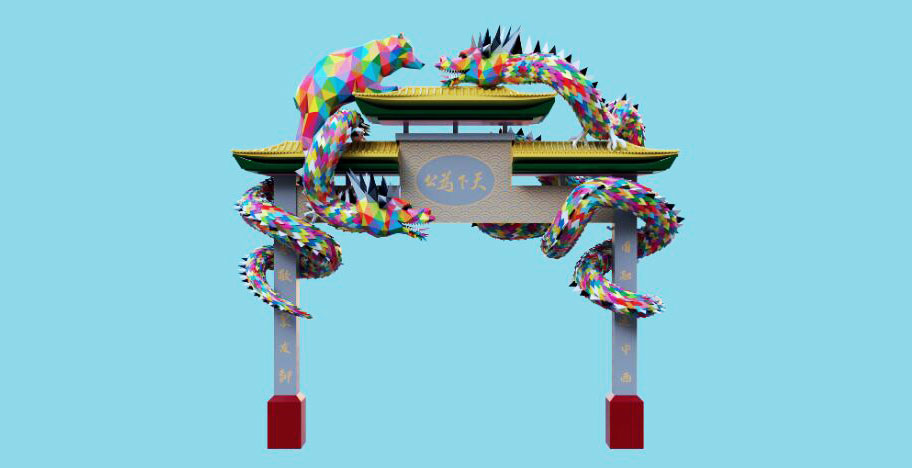
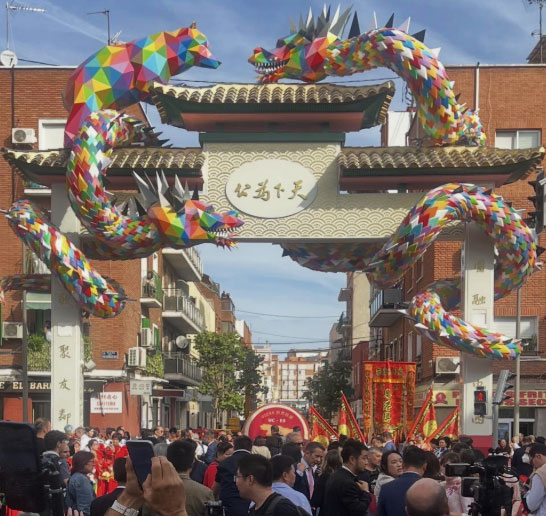
Usera has a new meeting point and a new way to tell its story. Madrid’s first Chinese arch, inaugurated on 1 October 2026 in Plaza del Hidrógeno, brings together two dragons and a bear in a composition representing the relationship between Chinese culture and the city.
Titled Two Cultures in Love, the work was created by Okuda San Miguel. His design combines the structure of a traditional Chinese arch with a contemporary sculptural installation, celebrating the coexistence that is part of everyday life in the district.
Standing 11 metres at its highest point and spanning 12 metres, with an 8-metre-wide passage beneath it, the installation has a monumental presence. Its meaning, however, is rooted in something familiar: the communities that share Usera’s streets, shops and public spaces.
An arch that tells the neighbourhood’s story
The work takes its inspiration from the paifang, the traditional Chinese arch that marks a place and honours its history. In Usera, this architectural reference becomes a creation connecting two identities through recognisable figures: Madrid’s bear and the dragons of Chinese culture.
The title, “Two Cultures in Love”, captures the intention behind the project. The three figures share a single structure, creating an image of connection, respect and belonging.
This message is also reflected in the Chinese calligraphy inscriptions featured on the arch. Phrases such as “The world belongs to everyone” and “Harmony is the most precious thing” bring the values behind the work into the public space.
Usera’s Chinese community has been involved in the design process. Its contribution has helped shape both the forms and the choice of colours, connecting the artistic vision with the people and culture it represents.
A new stop between Madrid Río and Usera
The arch completes the pedestrian route linking Madrid Río with the centre of the district, finished in early 2026. The route invites visitors to explore Usera on foot and discover references to Chinese culture along the way.
These include carp engraved into the paving and the dragon-shaped playground in Plaza de las Tizas. The new installation in Plaza del Hidrógeno adds an artistic landmark to the route and provides a stopping point from which to continue exploring the neighbourhood.
The initiative also aims to support local businesses. The city council hopes that interest in the work will encourage visits to Usera’s shops, restaurants and cultural spaces, creating further opportunities for the local economy.
The arch was commissioned by Usera District Council with an investment of €490,000. It forms part of a wider programme of improvements costing more than €10 million in total, supported by European NextGenerationEU funding through Spain’s Tourism Sustainability Plans for Destinations.
Art and community in public spaces
The inauguration brought together the artist, Okuda San Miguel; Madrid’s mayor, José Luis Martínez-Almeida; Usera district councillor Sonia Cea; China’s ambassador to Spain, Yao Jing; and Enguan Chen, president of the Unión Asociación China de Usera.
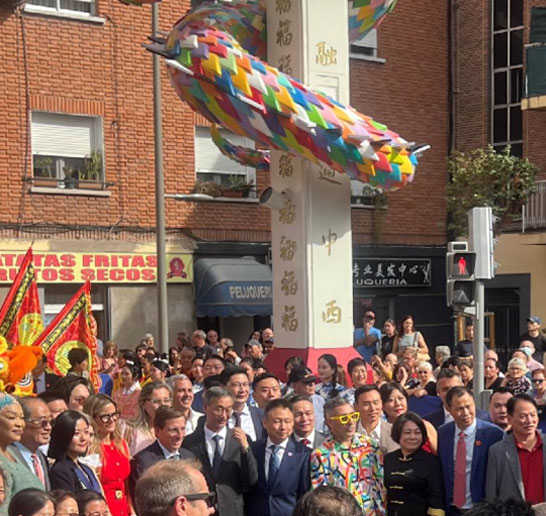
The unveiling was also linked to the Mid-Autumn Festival, scheduled for 2–4 October, with a programme of dance, crafts and food. Factory of Dreams, Okuda’s studio in Usera, also joined the programme with children’s workshops and an open day.
Beyond its inauguration, the arch’s significance lies in the role it can play in the life of the district. For those who live in Usera, it offers a visible expression of the bonds built every day. For visitors discovering Madrid’s Chinatown, it is an invitation to keep exploring and get to know the neighbourhood through its streets, its food and its community.